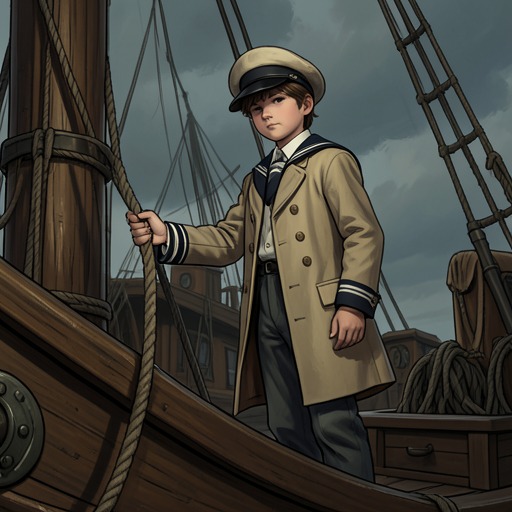
Vincenzo Florio's first trip to England
The Florios of SicilyVincenzo Florio’s first trip to England is both an escape from a thwarted young attachment and an education in the machinery and organization of industrial commerce. Sent abroad by Ignazio Florio with Benjamin Ingham, Vincenzo encounters a scale of production that Palermo’s spice trade has not prepared him to imagine; after five months, he returns with a proposal that could make those observations serve the family business.
Departure and purpose
Vincenzo is almost eighteen when Ignazio tells Giuseppina Saffiotti that he will leave for England in a few weeks with Ingham and the English merchant’s secretary. Giuseppina is shocked that her son is going away without her having been told. Ignazio explains that Vincenzo has asked several times to go, that Ingham has agreed to host him and take him along, and that the change of air will do him good. He also hopes the trip will make Vincenzo forget the young baroness.
The departure therefore carries more than one purpose. It gives Vincenzo a chance to see the wider world and learn, while offering Ignazio a way to interrupt a fixation he regards as troubling. When Ignazio asks what is happening between Vincenzo and the baroness, Vincenzo swears that there is nothing. But his uncle sees in his eyes a darkness he had feared would surface. The journey begins amid this unresolved tension: it is an educational opportunity, but also an attempted redirection of his attention.
A different landscape and scale
In Yorkshire, Ingham speaks to Vincenzo in English as they travel by carriage. Vincenzo studies the countryside through the window and admits that England looks different from what he imagined: he had expected many cities and houses, not so much rain, even in August. Ingham explains that ocean winds bring the rain, unlike in Sicily, where mountains stop the clouds. Even clothing becomes part of the adjustment. The suit made by Ingham’s tailor is warm and thick enough for the damp, and Vincenzo is struck by the softness of cotton shirts made on steam looms.
The trip compresses learning into a few weeks. Vincenzo encounters the ocean’s vastness, the cliffs of the French coast, and a sun that seems to appear only fleetingly. But what most captures his attention is the number of factories. Ingham promises to take him to one of his textile mills before they return to Leeds, and the visit brings the scale of industrial work directly before him.
Inside the textile mill
The factory makes its presence felt through noise and heat. Whistles, thuds, and a shriek that seems to come from the roof surround Vincenzo as he enters the dim interior. At first he senses bodies moving through the darkness; then he makes out men, women, and children working among the machines, their skin shining with sweat and cloth tied around their heads. Ingham says that more than thirty people are employed there. Their work is divided into stages: yarn is produced in one area, then worked elsewhere in the plant.
Ingham presents employment as a change in workers’ circumstances: some had been shepherds or home weavers, he says, and now have a steady salary and a roof over their heads. Yet the machinery also reveals the bodily cost hidden within the factory’s productivity. As Vincenzo leans toward a mechanical spool moving up and down, he notices a woman guiding cloth through a loom with two phalanges missing from her fingers. The scene places industrial order and workers’ exposure side by side: the system that organizes production does not make its dangers disappear.
The steam engine becomes the visit’s most vivid object. Beneath its black, grease-shining casing, heat activates the pistons; when Vincenzo gingerly touches a tube, he feels the motion vibrating in his palm. The machine seems to throb with life. Its power is not merely something Ingham describes: it is a physical force Vincenzo encounters, linking fuel, heat, motion, machinery, and the work of the people around it.
Lessons in commerce and production
After the visit, Ingham argues that a factory of this kind could not simply be transplanted to Sicily. He names conditions that Britain possesses and Sicily lacks: workers who, in his view, do not complain or make mischief, an abundant water supply, and, above all, entrepreneurs. His point is not that money alone builds an enterprise. Ideas and the courage to manage them matter too. He asks Vincenzo to consider which of Palermo’s spice merchants has as much business as the Florios, turning the mill visit into a lesson about ambition as well as technology.
That lesson unfolds against the larger commercial world Vincenzo already knows. Spices travel through a long chain of hands and transport: carried in caravans, shipped across the ocean, and brought to European ports, with costs accumulating at each stage. Once a trade that had enriched Venice, it is now dominated by British and French sellers bringing medicinal herbs and other colonial goods, including sugar, tea, coffee, and chocolate. Falling prices, expanding markets, and more open harbors have increased the number of merchants able to enter the business.
The Florios have made their own way through that network. Their warehouse at the back of the customs offices within Palazzo Steri holds spices in transit or awaiting sale. They pay import tariffs when goods actually enter Palermo, rather than before, and handle products obtained through British and French routes as well as goods moved by Italian sailors across the Tyrrhenian Sea. Their stockroom on Via dei Materassai has become too small. Against this background, Ingham’s question about the Florios’ standing in Palermo turns industrial observation into a business challenge: the family has risen quickly in a trade already shaped by foreign suppliers, maritime routes, customs, and competition.
Return and a proposed next step
The trip lasts five months. When Vincenzo returns in October, Ignazio and Giuseppina are waiting on the dock. Giuseppina embraces him with a mother’s possessive enthusiasm; embarrassed, Vincenzo first stands still and then looks toward his uncle. Ignazio gives him a nod, and the two shake hands. The restrained greeting marks the distance between a mother’s open welcome and the uncle-nephew bond through which Vincenzo’s education and future are being directed.
By the following April, Ignazio can see that the journey has altered him. The brokenhearted youth has been replaced by a proud young man with a determined expression. At home, Vincenzo tells his uncle about machines that do everything in half the time, describing steam engines, looms, and locomotives. Giuseppina repeatedly leaves the kitchen to stand beside him, kiss his hair, and listen with pride. Ignazio, by contrast, studies what the report might mean for business and concludes that machinery helps explain how the British can trade at such competitive prices.
Vincenzo agrees, then answers with a proposal: the Florios could offer the British what they need. He takes an envelope from his pocket and hands it to Ignazio. The episode ends not with the details of a completed venture, but with the beginning of a commercial possibility. England has supplied a view of industrial power; Vincenzo returns with the ambition to connect what he has learned to the family’s place in trade. The journey’s decisive result is that observation becomes an intended business strategy.